
Some damaged fire doors can be repaired and others cannot. It depends on the type and extent of the damage, whether the door can be identified, and whether the repair stays within what the door was tested and certified for. If you are unsure, have a competent person assess the door before deciding.
Why fire doors matter to landlords
A fire door is designed to hold back fire and smoke for a set period, usually 30 or 60 minutes, so that people can escape and the fire stays contained. Landlords care because a defective fire door can fail exactly when it is needed, and because fire risk assessments often list fire door defects as actions that must be dealt with.
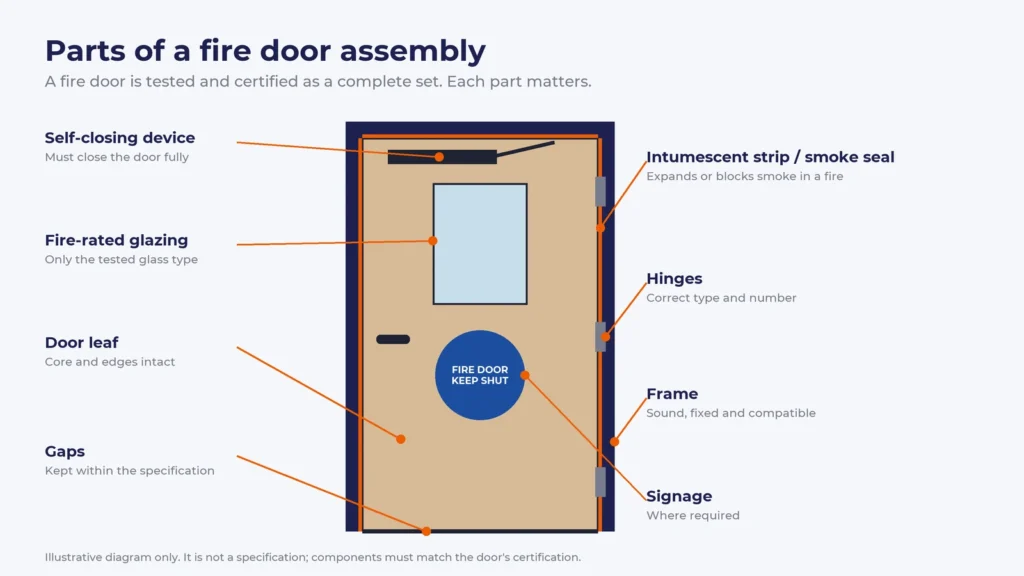
A fire door only works as a complete assembly. The leaf (the door itself), the frame, the hinges, the closer, the seals and any glazing or ironmongery are tested together. A problem with one part can affect the whole door.
In England and Wales, the Regulatory Reform (Fire Safety) Order 2005 requires the responsible person to manage fire safety in non-domestic premises and in the common parts of multi-occupied residential buildings. Since the Fire Safety Act 2021, this explicitly includes flat entrance doors in buildings with two or more sets of domestic premises.
In England, the Fire Safety (England) Regulations 2022 add specific fire door duties from 23 January 2023. In residential buildings with two or more sets of domestic premises, residents must be given information about fire doors. In buildings with storeys over 11 metres, fire doors in the common parts must be checked every three months, and flat entrance doors annually on a best-endeavours basis. The rules differ in Wales and depend on the height and type of building, so check what applies to yours. This article is general information, not legal advice.
Common fire door defects
Fire door defects range from minor wear to damage that affects the door’s ability to resist fire. The table below lists defects often found during inspections and what they usually mean for the repair-or-replace decision. It is a guide, not a diagnosis: every door needs to be judged individually.
| Defect | Why it matters | Typical direction |
|---|---|---|
| Gaps around the door that are too large or uneven | Fire and smoke can pass through the gap | Depends on the cause, such as wear, movement or poor fitting |
| Missing, damaged or painted-over intumescent strips and smoke seals | The seals expand or block smoke when fire reaches them | Often a component-level repair if the door is otherwise sound and the correct seal is used |
| Faulty, missing or incorrect door closer | The door may not close fully behind people | Often a component-level repair or replacement of the closer |
| Missing, loose or unsuitable hinges | The door may sag or detach during a fire | Needs checking against the door’s specification |
| Damaged leaf, such as holes, deep cuts or split edges | The door’s core may be compromised | Depends on the extent, location and the door’s construction |
| Damaged or non-fire-rated glazing | Glass can fail early if it is not the right type | Usually needs the correct glazing system, fitted by a competent person |
| Holes cut for letterboxes, vents or other fittings | Cutting can weaken the leaf or remove protection | May need specialist assessment or replacement |
| Damaged, warped or poorly fitted frame | The leaf may not seat properly | May need frame repair or full replacement |
| Door wedged open or tampered with | The door cannot close in a fire | Usually a management issue as well as a repair issue |
| No visible identification or certification | The door’s fire rating cannot be confirmed by sight | Needs competent assessment; missing labels alone are not an automatic reason to replace |
Can a damaged fire door be repaired?
Sometimes, but not always. Whether a fire door can be repaired depends on the damage and on whether the repair can be carried out in a way that is consistent with how that door was tested and certified. No one can say that every damaged fire door is repairable, and no one can say that every one needs replacing.
What determines whether repair is suitable
These are the main factors a competent person will look at:
- The type of damage. Worn seals or a faulty closer are generally different from a split leaf or a damaged core.
- The extent and location of damage. Small, isolated damage in a non-critical area is a different problem from damage across the leaf or frame.
- Whether the door can be identified. Knowing the door’s rating and manufacturer helps show what repairs are acceptable. A door with no identifiable certification is harder to repair with confidence.
- Compatibility of replacement parts. Hinges, closers, seals and glazing need to be suitable for the door in question, not just similar in appearance.
- Previous alterations. Doors that have been trimmed, drilled or fitted with extra hardware may no longer match their tested design.
- The condition of the frame. The leaf and frame work together, so a poor frame can limit what repairing the leaf can achieve.
- Manufacturer or certifier guidance. Some door makers and certification schemes set out which repairs are allowed.
This is why repairs should be left to competent people. This article does not provide repair instructions.
When replacement is more likely
Replacement is more likely to be the sensible option when:
- A competent assessment cannot confirm the door’s fire rating or origin.
- The leaf is badly damaged, delaminated or has lost its core protection.
- The door has been cut or altered in ways that cannot be reversed.
- The frame is damaged or distorted.
- The door has repeatedly failed inspections.
- The cost of making it compliant approaches the cost of a new certified door.
Missing labels or paperwork are not, on their own, a reason to replace a fire door. A door without visible identification may still be found suitable to keep after a competent assessment, while another may not. What matters is the competent person’s conclusion about the door in front of them.
A replacement should be a certified fire doorset, installed by competent installers, with the right frame, seals and ironmongery. Ask for installation records and certificates when the work is complete.
When to get a professional assessment
A professional assessment means a competent person examines the door and gives a view on whether it can be repaired, needs replacing or needs further checks. It is a sensible step when:
- A fire risk assessment flags a door but does not say what to do about it.
- You cannot identify the door’s fire rating.
- The damage is more than superficial.
- The door has been altered, for example by adding vents, letterboxes or glazing.
- Several doors have similar problems and you need to prioritise.
- You want a clear record of what was found and decided.
If the assessment shows that a door is not performing as it should and needs urgent attention, ask whether interim measures are appropriate until the work is done. If you have recently received a fire risk assessment, our guide on what happens after a fire risk assessment explains how to turn its action plan into completed work.
Repair or replacement: factors to compare
The table below helps compare the two options. It is not a rule: the right answer depends on the assessment of each door.
| Factor | Repair may suit when | Replacement may suit when |
|---|---|---|
| Damage | Limited to replaceable components | Extensive, or affecting the leaf or frame structure |
| Identification | The door is identifiable and records exist, or a competent assessment confirms it is suitable | A competent assessment cannot verify the door’s performance |
| Alterations | None, or alterations are within allowed limits | The door has been cut or modified beyond what is acceptable |
| History | A first-time minor defect | Repeated failures |
| Cost | Repair is clearly cheaper and appropriate | Repair costs are close to a new certified door |
| Disruption | A shorter visit is enough | A full doorset change is justified |
| Records | The repair can be documented clearly | New certificates and installation records are needed |
How Stratos Group handles fire door remedial works
Stratos Group arranges and manages fire door installation and repair works for residential and commercial buildings, carried out by vetted specialist contractors, with relevant credentials checked where required. We work on the fire door items that landlords, managing agents and housing providers have confirmed from their assessment or inspection.
In practice:
- We work from confirmed findings. You send us the assessment or inspection details and the doors involved.
- We set out the work. Our quotations describe the scope, so you know what each door needs.
- We recommend assessment where the answer is unclear. If it is uncertain whether a door can be repaired, we recommend it is looked at by a competent person first.
- We support related work. Fire stopping, fire alarms, emergency lighting and signage are within our fire safety services, so connected items can be quoted together.
Stratos Group does not claim that every fire door can be repaired. The aim is the right result for each door.
Frequently asked questions
Can a damaged fire door be repaired?
Sometimes. It depends on the type and extent of the damage, whether the door can be identified, and whether the repair is consistent with the door’s certification. Some doors need to be replaced.
How do I know if my fire door needs replacing?
A competent person can advise. Replacement is more likely if an assessment cannot confirm the door’s fire rating, the leaf or frame is badly damaged, or the door has been altered in ways that cannot be put right. Missing labels or paperwork on their own are not an automatic reason to replace a door.
Is it cheaper to repair or replace a fire door?
Repair is often cheaper for minor, component-level defects. When damage is extensive, or the cost of making a door compliant is close to that of a new certified door, replacement may be better value. A quote for each option helps you compare.
Who is responsible for fire doors in a rented building?
In England and Wales, this usually falls to the responsible person under the Regulatory Reform (Fire Safety) Order 2005. In buildings with two or more sets of domestic premises, that covers the fire doors in the common parts and the flat entrance doors. Who the responsible person is depends on who owns and controls the building, so if you are unsure, take professional or legal advice.
Should landlords repair fire doors themselves?
We recommend using competent people for fire door repairs. Incorrect repairs can reduce a door’s fire resistance without any visible sign.
How often should fire doors be inspected?
It depends on the building. In England, buildings with storeys over 11 metres must have fire doors in the common parts checked every three months, and flat entrance doors checked annually on a best-endeavours basis, under the Fire Safety (England) Regulations 2022. For other buildings, follow the schedule your fire risk assessment recommends.
Does Stratos Group repair and replace fire doors?
Yes. Stratos Group arranges fire door installation and repair works, carried out by vetted specialist contractors, as well as related fire safety works such as fire stopping, alarms, emergency lighting and signage.
Next steps
If you have fire door defects to deal with, send us the details through our quote form, including the property type, the number of floors and flats or rooms, how many doors are involved and any assessment findings you have. We cover London and selected surrounding areas; see areas we cover.